Education

Wealth Unplugged
“There’s a fine line between Grifter and Genius.”
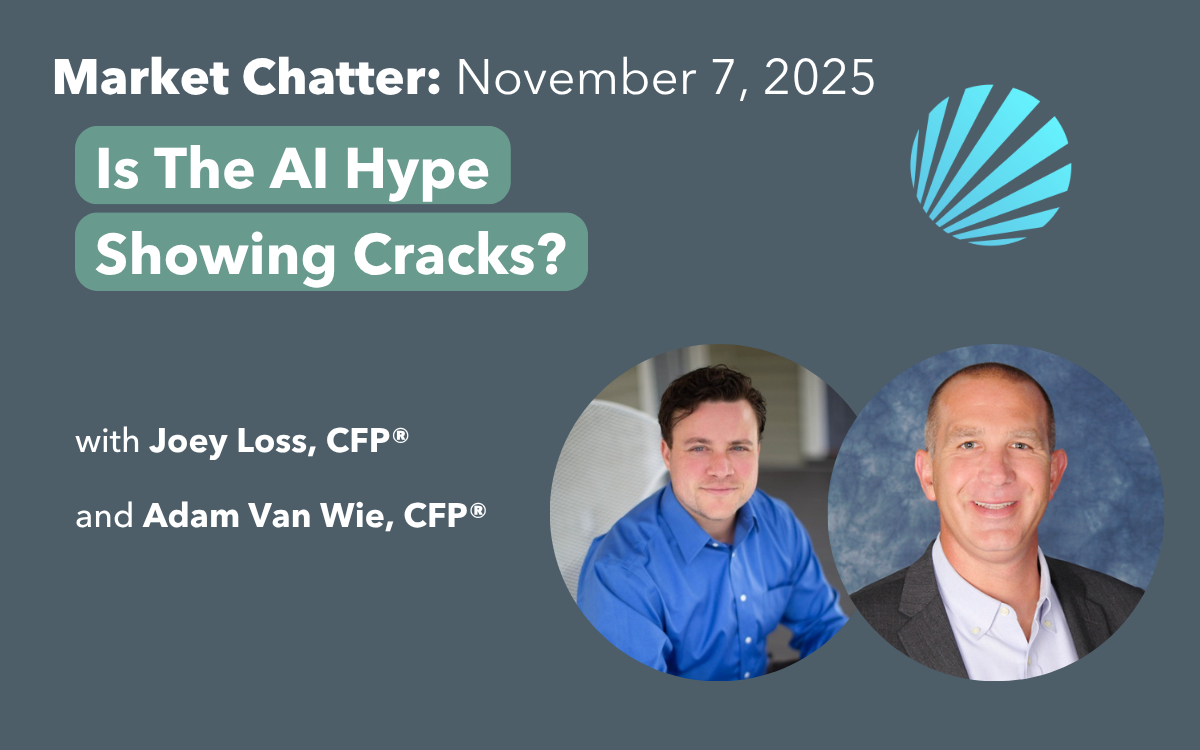
In this episode of “Market Chatter,” hosts Joey Loss and Adam Van Wie discuss recent market trends and concerns over a potential AI bubble. Adam shares insights from a Financial Planning Association conference in Vegas, emphasizing investment discipline. They analyze market performance, noting increased volatility and a rise in investor fear. Joey provides updates on major indexes’ year-to-date performance, highlighting the contrast between recent gains and short-term losses. The duo debates whether AI is in a bubble, referencing headlines and Sam Altman’s defensive stance on OpenAI’s financials. They explore risk factors, including government involvement in tech markets, and stress the importance of long-term investment strategies over reactive decisions. Concluding, Adam expresses optimism for end-of-year market trends, recalling the historical “Santa Claus rally” and advising investors to maintain a strategic allocation despite short-term fluctuations.
Read our audio, video, and written content disclaimer here.



Key Topics
- Introduction and Adam's Vegas Trip (00:00)
- Market Overview (02:11)
- Market Fear and Volatility (05:04)
- I Bubble Discussion (07:26)
- Comparison to Historical Market Events (21:13)
- Thematic ETFs and Investment Strategy (30:00)
- Job Market and Amazon Layoffs (34:46)
- Closing Remarks (37:40)
Joey Loss 0:01
Right. Welcome to another episode of Market Chatter. It's been a little while. I'm Joey Loss.
Adam Van Wie 0:07
And I'm Adam Van Wie.
Joey Loss 0:09
And so we're going to run through kind of what's been going on. But yeah, man, we've had a hiatus. Adam was in Vegas, won a couple hundred bucks. How was that?
Adam Van Wie 0:20
Yeah, actually more than a couple. But that has literally never happened to me before. And I'm not recommending it as a retirement plan, but I was out there for Financial Planning association conference and just got a little hot at the blackjack tables.
Joey Loss 0:36
No, that's awesome. And you broke the golden rule, which is why you have winnings, which is you walked away from a heater.
Adam Van Wie 0:42
I did. I. I won the first two nights and I was actually there for a third night and I said, nope, I'm going to bed. And I'm not. I'm going to walk right past all the tables and not give back what I've made.
Joey Loss 0:53
See, for listeners, that's the kind of discipline that gets you the title of chief investment officer. Not everybody has that. That's true. All right, so I obviously the market has been doing market stuff. I'm going to run through some numbers, but I want to talk about what's going on. We're seeing fear rising, a couple different phenomenon going on. Headlines are starting to spook some people. We see the CNBC fear greed index leaning a lot more towards fear. That hasn't been the case for the whole year. You know, obviously in April around tariff season, we had a lot of that going on, Tom. But then things calm down and the market soared. So I'll catch us up and then let's kind of dig into what is going on. So the S and P year to date is up 14.26%. This quarter it's up about a half a percent. And over the last 10 days it's down 1.5%. So the momentum has changed there. Dow Jones year to date about 10.27%. Quarter to date we're up about 1.1. The 10 day is negative 0.76%.
Joey Loss 1:54
And then the NASDAQ, which has been the champion of all US indexes is up 19.6% year to date. God, that is a crazy number. Quarter to date it is up 1.82%. And over the last 10 days down 1.71. The Russell, which represents the small cap companies in the US indexes is up 14.6%. Quarter to date it's down actually 0.72%.
Joey Loss 2:21
And the 10 day is negative 4.64. So it's seeing some volatility. And then internationals, which have kind of quieted lately, are still dominating year to date performance. Developed markets are up 32.09%. And emerging markets. I'm sorry, I'm flipping these emerging markets are up 32.09%. Developed markets are up 26 and change. So overall, it's been a great year. But Adam, what is going on right now?
Adam Van Wie 2:49
Well, yeah, we've just seen a little pocket of weakness here this week. It's nothing that I'm super concerned about. I, in fact, like it when the fear index is higher. I, I think that people get complacent as investors and you see a run like we did post April until now with very, very little volatility, and that's just not a normal state for the market. I think that when there's a little bit more volatility, it shakes out some. The, the real, when you, when that happens, when we see a period like we did in the last six months, you start to see pockets of the market that, you know, are very, very risky and they just start going crazy. People are buying it, think that it can never go down. You see, it's like euphoric. But that's not, that's not real. That those things, a lot of these things like quantum computing were, were just going nuts for the last six months and, and they haven't even come out with a product or a computer profit. And it's, it just doesn't make any sense. It's highly speculative and I don't like when those types of things get too crazy. We saw it a few years ago on a much larger scale and then everything just kind of imploded. And that, that's what I think will happen when you start to see things like that. So the fact that there's a little bit more fear in the market right now, I, I actually think is a good thing. From a seasonal perspective. We're right now entering the best three months of the year. We're actually into it at this point, but typically you see a Santa Claus rally. That's a real thing. It sounds gimmicky, but it's been proven throughout time that this, this, this time period, the end of the year is the best time period in the market from a historic perspective. So I'm, I'm pretty, I'm pretty good with where the market is today.
Joey Loss 4:47
You know, people keep talking about, we get a lot of clients coming in and asking about, are we seeing an AI bubble And the headlines are responsible for that. But I want to talk about that because there is, you know, I think it's easy for us to say, no, this is not necessarily a bubble. Not that you need a bubble to lose 50% on stocks. That can happen at any time. But bubbles obviously make that more likely. I think it's easy for us as advisors who get to look at this data and are so used to looking at long term outcomes to say, not really. I mean, the fundamentals are there as long as earnings are there. And we had a record earnings season where people keep beating expectations.
Joey Loss 5:28
You can't call it a bubble necessarily. But at the same time, we do see all of these major mega tech companies, AI companies, just cross investing in the stocks rising as a result. What do we make of that and how do we couch that in our broad view of what's going on right now?
Adam Van Wie 5:45
Yeah, I really am starting to hate the term bubble. Everyone always wants to point to the next bubble and say that we're in a bubble here, we're in a bubble there. No one's ever right about it. And if it were that easy to predict a bubble, we wouldn't have bubbles. It just, it would be too easy to avoid them. And therefore people wouldn't put their money in when they knew, when they were absolutely convinced it was a bubble. So the fact that people are saying an AI bubble leads me to believe we're not in one. And sure, AI has dominated the headlines. It's dominated profits really for, for the last, I don't know, year, two years. And yes, that can be a little bit scary. But look at the results. Look at what Nvidia is doing. Look at their bottom line. It's, it's off the charts. Good. And so it, this is not, this is not the tech bubble from the 90s or late 90s. This is, this is something different. It could be a sea change in the way that businesses operate. I don't know. I mean, maybe it's somewhere in between a bubble and that, and that's probably the most likely answer. But will things, will the stock market take this thing too far? Absolutely. It always does. And then it corrects and gets back on track. But that doesn't mean it has to be a too 2008 style crash. It could be a, it could be a 12 correction and maybe we're right where we need to be. But will it happen this year? I don't know. No one knows. Anyone who tells you that it's going to happen this year is lying. They don't know that they're guessing. And it could be three years from now when we see the correction that needs to happen. There's just no way to predict that. So essentially, if you're an investor, a long term investor, the real answer is don't worry about it. Just continue to rebalance. Sell the highly appreciated tech stocks, buy some value stocks this year and, or, or bonds or whatever it is that has underperformed in your portfolio. Sell off a little bit of that international that's done so well. Buy something that hasn't done as well if you can, find something that hasn't done as well and, and get things back on track and just do what you're supposed to do and you'll be fine.
Joey Loss 7:58
Yeah. You know what these headlines don't talk about is what is the risk that you take on if you're wrong and you treat it like a bubble?
Adam Van Wie 8:05
Oh, you sell too early and you. And you lose all that additional profit that you would have made.
Joey Loss 8:11
Right. And you know, if you're doing real financial planning and looking at all the statistical analysis behind market performance and possibilities and your plan looks good, you got to realize that bubbles and big market events are baked into those results. And so if you're reacting in the short term, you're actually almost. I mean, you're so much more likely to hurt yourself by trying to predict what the situation is. Then you are likely to sell at the right time and then buy at the right time later. Not to say it's impossible, but I haven't met anybody that's done it. And the only guy I know of who did anything like that and got notoriety for it, his name's Michael Burry and he had a movie made about him and he's been wrong about recessions like nine times since.
Adam Van Wie 8:55
They quote him so often and they always, the headline always says, man who correctly predicted the 2008 crash predicts X. And he's always wrong.
Joey Loss 9:05
Yeah. What does your dad say? He predicted like nine of the last two recessions or something.
Adam Van Wie 9:09
Yeah. Correctly predicted nine or. Yeah, two of the. Or ten of the last two recessions.
Joey Loss 9:16
Yeah.
Joey Loss 9:18
Yeah. So I just. Yeah. If you're, if you're. This is back to the strategic asset allocation idea, to Adam's point about rebalancing and things. If you have the right allocation, you can weather whatever's going on. And the truth is you probably can't weather missing a huge market. Does that mean we're saying buy? No, we're not giving a recommendation. But we're just Saying in the world of investing over a lifetime, this is how this piece works.
Joey Loss 9:45
But to continue advocating for the other side and just kind of pointing at some of the oddities that are going on in the AI space. Sam Altman had a very strange week with OpenAI, and so did his CFO. His CFO Sarah Fryer was speaking at a Wall Street Journal event this week and she suggested for a moment that the government should backstop or guarantee loans for AI infrastructure, particularly OpenAI, with the goal of lowering financing costs for the massive amounts of compute power that they need. And everybody just, I mean, social media blew up. Anybody who's watching the space thought that was the strangest suggestion, including David Sachs sar, the crypto czar, who is a tech, you know, mogul himself, just said, that is the most horrible idea I've ever heard.
Adam Van Wie 10:35
Yeah, that's absolutely bizarre. I don't know where that would have come from and I would be strongly against it. I don't think that makes any sense at all.
Joey Loss 10:47
Yeah, I mean, I think that's how you create a bubble, right? You get all this supplemental liquidity based on printed money into a idea of a business that may work out on its own, in which case you've treated it properly by letting it figure out whether it's successful or not. But backstopping this with presumably hundreds of billions of US dollars by the government is probably not the way to figure that out.
Adam Van Wie 11:11
Yeah, I, I honestly, I believe that if the government gets involved, you're 10 times more likely to turn something into a bubble because it makes things artificially cheap to the, to the consumer. I mean, I think we're seeing a little bit of it in the electric car market right now with the subsidies going away. And look at that. The Ford Lightning may be discontinued now because the, they sold 120 of them I think last month or something, compared to like 40,000 gas powered F150. So I just think that government subsidies are way more likely to cause a bubble than free markets.
Joey Loss 11:53
Yeah, I mean, they're a tool for like real devastation, but man, they got to be cut off at the right time or they do create that situation.
Adam Van Wie 11:59
Exactly.
Joey Loss 12:01
And so, I mean, the good news is, you know, whether, because she was wrong, the CFO in speaking for OpenAI this way or not, or Sam Altman just saw the response and freaked out. He said governments should not pick winners and losers and the taxpayers should not bail out companies. OpenAI is not seeking a backstop. So that was his Twitter response.
Joey Loss 12:23
Again, you don't know where that comes from. But she said her use of backstop muddled the point. So who knows if they're just kind of covering their butts because there's a, a real misstep. And also, I mean, I think the challenge with it, you know, is for investors, that almost sounds like, you know, you don't have 100 faith in what you're doing. If you're asking for that kind of thing.
Adam Van Wie 12:45
Yeah, that, that is, I, as a C level executive, to say something like that, you really have to question what the motivation was there. It doesn't, I can't make any sense of it, to be honest. It seems very bizarre and also kind of shooting yourself in the foot.
Joey Loss 13:04
Yeah. And the reason this matters so much with OpenAI is obviously, you know, from a retail perspective, everybody knows of chat GPT, but ChatGPT's future, OpenAI's vision of its future is being a huge piece of infrastructure that impacts all of these other tech companies and as a platform of compute and AI power on which all of these other ideas are someday built. And right now they have revenue of 20 billion, which is nothing compared to valuations and the way that they're being perceived in the market in terms of a value. But they presume that they're going to have hundreds of billions of revenue by 2030. And right now the rumor is if there was an IPO in 2026, that they'd be valued at a trillion. And I'm just telling you, 20 billion of revenue, totally different than profit. Right. There's almost certainly not profit with a trillion dollar valuation. That is a bit rich. And so I think that feeds the fire of AI bubble concerns. And when you see the cross investing and now Microsoft is involved with OpenAI,
Joey Loss 14:10
I get why people are nervous. And I think the thing that we have to watch is really just earnings of public company stocks relative to the valuation.
Adam Van Wie 14:18
Yeah, I mean, I said the same thing about Amazon for so many years. How did they justify this valuation when they never made a penny? But you could see the growth trajectory and you have to apply that to future earnings and that's how you get to a trillion dollar valuation. But sometimes it seems like pie in the sky. But look at what Amazon has done since they turned a profit now they're massively profitable. So that's. So it's. If you don't have that kind of, that kind of foresight to see what's going to happen in the future, to do your discounted cash flow models and project out into the future, it can seem like crazy valuations being applied to these growth companies. And so it is easy to see why people get caught up in that. This is a bubble type of talk.
Joey Loss 15:10
And the last red flag that showed up this week for OpenAI, which again was just a big week for them in terms of public focus.
Joey Loss 15:19
On a recent podcast called BG2, Altman was pressed on the financials of OpenAI and he became alarmingly defensive and hostile. Which, honestly, if you've watched him at Altman, he's a quirky dude. I mean, that's not terribly weird for him to have just a weird energy about him and not really answer questions properly. But he became noticeably defensive and hostile and started dismissing traditional financial modeling for companies, refused to give any specifics, which technically he doesn't have to do as a private company. And instead of answering, he just kind of pointed that Twitter likes to make noise and he could sell plenty of shares to people that do believe in OpenAI as a model.
Adam Van Wie 16:02
Okay, I mean, tech dude having a weird day that, that, I mean, if you look at Zuckerberg, he's weird more than he's not. So I, I don't know if that's really anything more than just being pressed about something he didn't really want to discuss. I mean, if I'm a private company, I'm not disclosing my financials on a podcast either. So I, I don't know that that's really that notable. But in the context of everything else, if you're really looking for something, maybe, I don't know, it seems like far fetched.
Joey Loss 16:35
Yeah, I mean, it depends what you blanket attached to. So I think if you just say, you know, weird day, you know, you've already minimized it. But I think if you focus on,
Joey Loss 16:45
I think what people are focusing on is the fact that in other times where we were in a bubble, so particularly.com stuff, people would, you know, it was common for CEOs to freak out and say, well, you don't understand the financials. They lean on the growth factor. And they say a lot of these factors about discounted cash flows and things like that, which are all valid points, but we have to realize our assumptions are also made up. The environment can change, things can change. And so
Joey Loss 17:12
if those things are true, then our valuations are perfect, but they never are. That's why people can't predict stock prices. And so what they were freaking out about is the idea that his defensiveness just reminded them of the trauma of previous things. And the reason I think that's so Interesting is because, you know, there are people to your point that have gotten away with that. I think there's a fine line. I heard it said there's a fine line between Grifter and Genius. You know, like, if you. If people remember what was that company that did the blood testing and you know, she was like a genius.
Adam Van Wie 17:48
Yeah, but that was like this.
Joey Loss 17:52
Yeah, this is how they talk and.
Adam Van Wie 17:54
Never even had a product. That's the big difference. Everyone's used chat GBT at this point, but, like, I can't remember the name. It was the female CEO. They legitimately never had a product. Totally different scenario.
Joey Loss 18:09
I wouldn't say totally. I mean, and I'm not saying this is that, but totally different is. I mean, where's the revenue? Right? So, like, there's no revenue yet in a meaningful way. You've got 20 billion of. So they're going to trade at 50 times sales and they have
Joey Loss 18:25
almost assuredly no profits. We don't know. But I assume at 20 billion for OpenAI, there's not a ton of profit when their compute costs are what they are and they're worried about financing. And so my point is not to say that I think it's a bubble, because I don't. So I want to be clear on that. But the reason I'm saying that this. I get where people are coming from is because I think it's important to understand for. For listeners like the. The fears come from someplace. It's not just headlines. There's a context for why this is the way it is. And it can go either way. You can end up in a situation where you have the blood company and God, I wish I remember the name. And then in the. On the other hand. On the other hand, you look at Zuck like Zuck talked like this and kept his company private forever. And then when they went public, look what they've done since then. Right. I mean, it's been a tremendous success. So I think people realize that right now we're kind of putting faith in a few big figures to prove through the continued growth of what they're working on that they're not grifters. This is a wonderful progression in our tech.
Adam Van Wie 19:23
Yeah. So that company was called Theranos, and Elizabeth Holmes was the CEO, who. I mean, she just lied. That was fraud. She. She said she had a product that could do something that there was no. There was no product that could do what she was saying. She was saying that she could do a blood test for all these different diseases and then shipping it out to your local lab and getting the blood test done in the traditional manner, not by this machine that, that she said she had, that she didn't have. So I think that's different because ChatGPT is a real thing, we've all used it, it produces results, it's very, very helpful in daily life. And maybe the revenue isn't there today and that's what is bothering him. And I could see that. But the fact is they're not a publicly traded company. They haven't got IPO'd at a trillion dollar valuation. And maybe he wants to, maybe that's the goal and maybe he's not, maybe the revenue isn't, isn't projecting out to get to that trillion dollar valuation. That's entirely possible, but it doesn't matter because it hasn't happened. So if they IPO and they're only at a 500, you know, billion dollar valuation, it is what it is that, that it'll matter at that time. But does it matter today? I don't know. Like, is Nvidia's valuation tied to the valuation of Chat GPT? Not really. If Chat, if, if they're buying Nvidia's products at the current market price and Nvidia is public so we know their results, then it doesn't, it doesn't really affect that, that valuation. So I, I guess I'm just wondering why this is the canary in the coal mine or if people are really just looking for a canary in the coal mine.
Joey Loss 19:32
She.
Joey Loss 21:16
I think, I think people don't want to be surprised to be wrong if they're staying invested. And you know, the pain of negative outcomes is just so much greater than the joy of success that I think this drives a lot of what people focus on. And I played a hard devil's advocate just to get the full explanation as a great explanation. And I agree with you. I think there is a product here. I think we are seeing movement in the right direction. There's a reason these great big public companies are kind of cross playing together. I think on one hand it's the biggest important bet of potentially all of their lifespans is to cooperate and figure this thing out together. But on the other hand, they're not going to risk what they have to invest in something. I would presume they're not going to risk what they have to invest so heavily into something that they thought was a fraud or didn't have any value or anything like that. So in some ways it's a risk level to the market, but in other ways it's a show of faith of what they're all working on collaboratively. And I think the most likely outcome is probably positive and history would suggest that positive outcomes dominate over the long term.
Adam Van Wie 22:28
But so I, I have, I have a much bigger fear with OpenAI and chat GPT and that is that they are the Yahoo of, of this generation. And, and what I mean by that is at one point Yahoo was widely considered the front page of the Internet. Basically everyone's browser default was yahoo.com it had the email, it had all of these different tools that you could use. Now it's an, it's almost an afterthought in the history of the Internet and their, their share of people that use it relative to share of people using the Internet is minuscule. And they had what we call a first mover advantage. And so people just got familiar with the brand name. It was a, it was at the time a really easy site to navigate. But they kind of got comfortable with that and they lost that advantage over time. It just eroded to other places, to other things. Google came out and killed them on search and that really was I think the death blow of Yahoo. And I could see a scenario like that with ChatGPT because it isn't that defensible if someone else comes up with a better large language model and has a better search result. Why would you use chatgpt you. When you can just go to Gronk.com or whatever the next one is.
Adam Van Wie 23:57
So I, I do worry that their pro. Their situation is less defensible than, than what they would like it to be. And, but that doesn't spell the end of AI that might spell the end of OpenAI. So that, that is my concern with them much more so than it being an overall bubble.
Joey Loss 24:17
Yeah, that's an interesting thought because this is, and it's in a way, I mean we just don't even know what five years from now what we're going to be thinking. I mean if you think back to 21 pre chat GPT, could you have imagined the way that you just regularly use a chat bot right now?
Adam Van Wie 24:33
No, no. And it's changing so much faster than it has in, in history. So I think your five year time horizon is really like one year. Maybe it could change that fast.
Joey Loss 24:45
Yeah. And so I mean I raised that to point that like, you know, at the time Yahoo was the bee's knees. Everybody had one. And I remember when I met my wife and realized she had a Yahoo email address, I was like what the heck.
Adam Van Wie 24:56
Yeah, I'll date myself. My wife was using dial up AOL when I met her.
Joey Loss 25:04
So, yeah, these things change. I think there's a great point there. And you know, certain companies like Facebook
Joey Loss 25:12
and particularly Google has just done such a strong job of
Joey Loss 25:18
staying on the frontier and investing heavily in what's coming and grabbing a piece of that so that they stay relevant and then using their original search business to be kind of the foundation of all these other things. And I think if any one of these AI companies wants to stick around for the long term, we're going to have to watch and see what are they doing to, to stay on the frontier while balancing being excellent at the main thing that's popular right now.
Adam Van Wie 25:46
Yeah, I agree. And I think, I think Gemini is a real threat to chat GPT
Adam Van Wie 25:53
and so it'll be really interesting to watch how it plays out. But there will be winners and there will be losers. But trying to predict that today is next to impossible.
Joey Loss 26:04
Yeah, and that sounds like a perfect plug for
Joey Loss 26:09
why broadly investing in what is going on, not just even in the AI sector. I mean, I think we've talked about AI thematic ETFs
Joey Loss 26:19
on this podcast and just thematic ETFs in general. I think we both have kind of a negative view on them. Do you want to just share that real quick?
Adam Van Wie 26:28
Yeah, I really don't like thematic ETFs. And the reason is that they usually are terrible at actually picking the stocks that have the influence on whatever sector or part of a sector or theme that they're trying to, to mimic. And they, they often, they often are weighted down, they'll get one stock. Right. But then they, they feel like because it's an ETF, they have to have 20, let's call it 25 stocks. And so they pick things that are loosely related, like, that have revenues and other parts and things completely unrelated to the theme that they're trying to, they're trying to emulate. And it ends up dragging down the performance of the overall etf. And it doesn't, it doesn't mirror what's happening in the theme or the sector that they actually try and try and cover. And so I think it's, I, I just don't, I just don't find them useful. And I, I rarely, if any, we'll, we'll consider them in our portfolios anymore. I think that if you want to own something specific, then you all, you really have to dig down and buy the actual companies that are doing that. I don't condone that because I don't think you're going to be able to pick out the. It's stock picking is such a, a bad proposition for making money over the long term. I think that you're better off just owning the technology index. And I mean if you've owned QQQ for the last three years, you've made like over I think 70% on it. So what if you're not happy with that return? I don't know what to tell you.
Joey Loss 28:15
Yeah, yeah. At that point you're just gambling. And I think the thing that I noticed the most is when you're, when a technology comes out or something is revolutionary, the winners and losers are not always in that sector. I mean if you look at AI on its own, I mean that is a hard thing to be profitable in right now. Pure AI. If you're the source company of this technology, you're not printing money yet. I mean hopefully, and that's what we were talking about. But the winners are
Joey Loss 28:45
companies that get to leverage the power of AI to do. It's not necessarily a popular thing but layoffs that then increase profitability and efficiency. Right. Because they now have this technology that allows them. Look at Salesforce and Amazon recently laid off of the $350,000 corporate force. They laid off 14,000, which is a little over 3% or a little under 3%. But not, you know, that really shook the market a little bit for the day and headlines but in the scheme of things, not a big deal. But it's a big deal for the company because that's a lot of salary that they don't have to pay that they can now leverage AI for and potentially I guess in their view, do equal or better work. And Amazon is going to be a winner in the short term. And if you're focused on an AI fund, you're not going to get the revenue boost or the profit boost from Amazon
Joey Loss 29:40
in proportion to I think what you're aiming at. And so by owning everything,
Joey Loss 29:45
you give yourself the opportunity to benefit from all the winners whenever those winners might be winners.
Adam Van Wie 29:52
Yeah, you would have been probably much better off. I was way off on my number. Q. Q. Q. Is actually up 135% in the last three years. And if you own the, the semiconductor index like SMH, you would have been up almost 275% at the same time. So I find that Those type of ETFs that cover an actual index or, or a, a broad technology sector, I find they work way better than these thematic ETFs that say they're going to cover the AI AI space or any other space for that matter. So definitely take a look at those two funds. They're tried and true. They're, they're, they have billions of dollars of AUM and they are held by legitimate companies that, that are, that you just can't go wrong with. I mean, the ETF provider itself in Invesco and Vaneck. And so those are the type of things that we would invest in rather than buying some sort of like very small AUM thematic ETF that is probably going to be out of business in three years anyway.
Joey Loss 31:02
Yeah, I think, you know, funds like what you're describing play a right role for the right portfolio in a much healthier way.
Adam Van Wie 31:10
Definitely.
Joey Loss 31:12
Awesome.
Joey Loss 31:14
Anything? We haven't talked about jobs, I mean, in general, I just touched on Amazon. Is there anything there that listeners need to know about? It's been a little while since you.
Adam Van Wie 31:21
Touched it, the Amazon thing. I don't know. I feel like we read that they tripled their workforce since 2018. We all know what the last five years have looked like in terms of hiring. It's been impossible to hire good people and you have to overpay for someone who may not be exactly what you're looking for. And this has been true outside of technology, all across different types of jobs in the, in the US and worldwide, from what I understand. So in the last year or two, that's really cooled off and we've come back to a much more normal job market where people aren't quitting their jobs every six months to go take a, you know, $20,000 a year raise. It's just, it's not where people, it's not where corporations are fighting over the next marginal hire anymore. There are people available, but it's not like it's impossible to find a job either. So it's a, it's a much more balanced market right now. So it's not hard to think that during the last five years or since 2018 even, that Amazon may have picked up some dead weight and not been able to get rid of it because they have been so busy and so trying to hire at such an intense rate that maybe there's some underperformers in there. 14,000 people is not less than 3% is really not that, not that big of a deal to me. And if you go back to the old Jack Welch at GE Days, he said that there were 10% that you need to fire every year just to shed the people who were underperforming. And so 3% reduction for the first time since 2018. My. It kind of just shrugs. I'm going to shrug my shoulders and, and see what happens next.
Joey Loss 33:12
Yeah, I think that's. I agree with that take.
Joey Loss 33:17
Yeah. Particularly with Amazon. I mean, 350,000 in corporate, that's a huge corporate to begin with for. I mean, even though they're the store for everything successfully, you know, it just seems like a huge workforce.
Joey Loss 33:33
So. Yeah. Okay. Well, I think that's all I've got, Adam, anything else you want to touch on?
Adam Van Wie 33:40
No, I mean, if we, if we see it. Well, we're going to see a down week this week. I think it's all. All but finalized here. I just wouldn't worry about it that much. I mean, we, we've been on a. On a real tear ever since April and this, this year has been fantastic. So even if we went down 5% to end the year, it would still be a really good year by pretty much any measure. So don't get too worried about it at this point. And hopefully headed into the holiday season, we do see a Santa Claus rally and end the year with one of the better three year runs that I can remember in history, so. So yeah, it's been, it's been a lot of fun and enjoy the ride.
Joey Loss 34:23
Yeah, that's a good ending now. All right, man. Appreciate it. Adam, good talking to you.
Adam Van Wie 34:28
You too, Joey.