Education

Wealth Unplugged
“Cash reserve is the foundation of a home”
“You can’t borrow for retirement, but you can for college”
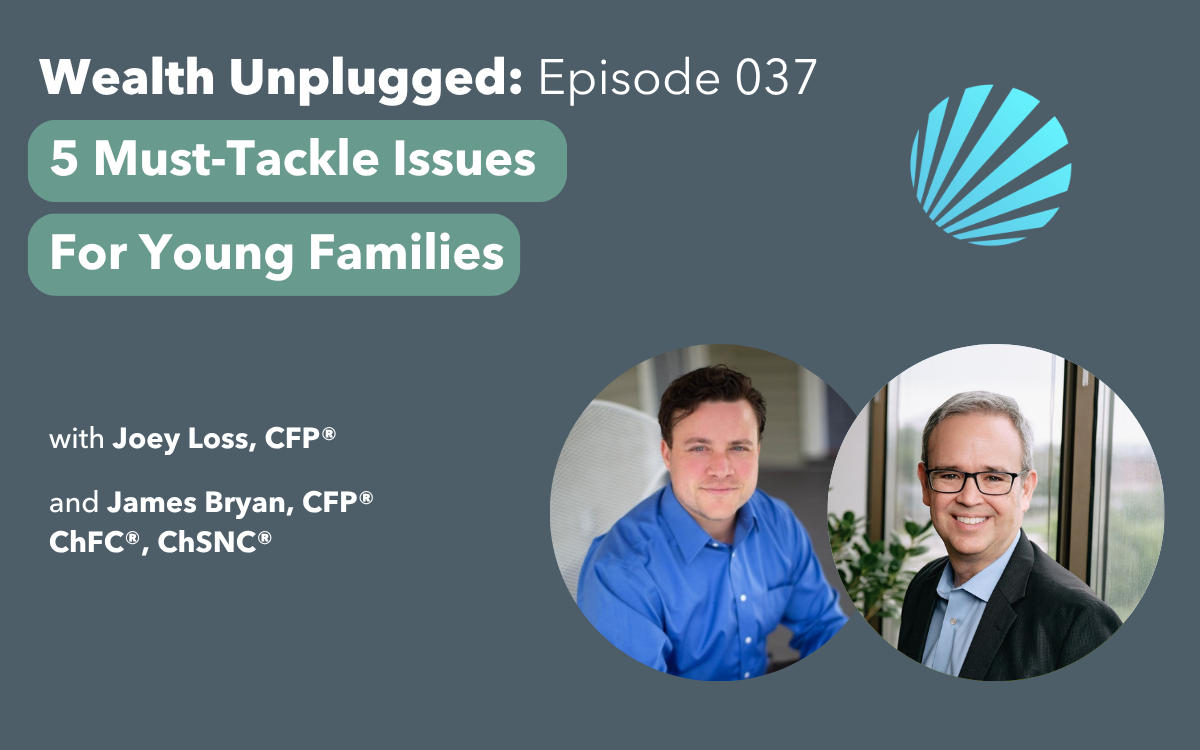
In this episode, Joey Loss interviews James Bryan, a seasoned CFP®, to discuss essential financial planning pillars for young families. They cover topics from emergency reserves and insurance to estate planning and investment strategies, providing practical advice to set families up for long-term success.
Read our audio, video, and written content disclaimer here.



Key Topics
- (00:00) Introduction to James Bryan and episode overview
- (02:12) The importance of emergency reserves and how much to keep
- (06:12) Where to keep your high-yield savings for accessibility and growth
- (07:58) Prioritizing savings: retirement vs. college funding
- (12:06) Adjusting savings as family needs grow
- (16:55) The critical role of life and disability insurance
- (27:52) Estate planning essentials for young families
- (34:54) The significance of investment decisions and long-term planning
Joey 0:00
Welcome back to another episode of Wealth Unplugged. My name is Joey Loss, and today my guest is James Bryan. James is a certified financial planner and the founder of Highland Lake Partners in the Twin Cities, where he leads a comprehensive planning team. He's been doing this for more than 20 years. He sits on the CFP® Board's Discipline, Disciplinary and Ethics Commission, which is a very interesting position to hold. So he's one of the people who helps hold our profession to its standards, and he serves on the board of College Possible Minnesota, helping first-generation students get to college. James Bryan, thanks for coming on the podcast.
James Bryan 0:34
It's an honor and a pleasure, Joey. Thank you for having me.
Joey 0:37
Yeah, we met a few weeks ago. Well, I guess a couple of months ago now at the NAFSA Spring Conference, which happened to be in your neck of the woods. And I think over an evening beer after our academic sessions, we just kind of connected. And I thought it would be a lot of fun to have you on here. So I appreciate you carving out the time and letting us make it happen.
James Bryan 0:55
You're absolutely welcome. I'm looking forward to it.
Joey 0:58
So To get started, I thought the topic that would, would be a lot of fun for us, just based on previous conversations we've had, would be kind of a no-nonsense discussion about like what helps, what do young families need to be prioritizing when it comes to finances? Because there's a ton of information out there and I just think if we run through a punch list, maybe I throw out some, some common beliefs or some stats and just have you respond to them and let's see what we can put together as a basic blueprint. For young families. What do you think? All right. So to get started, I think pillar number 1 is emergency reserves. So Bankrate's latest report found nearly 1 in 4 Americans have zero emergency savings, and only about 4 in 10 could cover a surprise $1,000 bill out of savings. A quarter of people would reach for a credit card at 20%+ interest. For a young family, that seems like the difference between a speed bump spiral. What are your thoughts on that?
James Bryan 1:27
I love that. Let's go.
James Bryan 1:54
Oh, the, in my opinion, the, uh, the cash reserve is the equivalent of the foundation of a home. I like, I'm a big fan of metaphors. I use that a lot in my daily client interaction. So the cash reserve is there for all the unexpected events. And as we all know, as you get older, we all have curveballs thrown at us that we have to deal with. So, uh, having the cash reserve, we ideally, you know, we like to see a minimum of 3 months of living expenses. Expenses. And that is the level all people should strive to have there if they want to protect themselves and have the means to afford all the things that come along, like, you know, having to replace new tires. You know, you have a blowout on the highway, got to replace tires, planning that there was no 2-week notice for it. Or if you have to replace something on your home, you discover your hot water heater's out and, and they don't give you a 2 weeks notice either as well. So in my opinion, the cash reserve is, is very, very critical and we really push that really hard, not just with our clients, but everybody I know, all my friends, we have that conversation. And so the, the more cash you have, Dec, the more independence you have and the more security you have.
Joey 3:15
Absolutely. It seems like one of the few things where I don't really need to know about your situation to give that piece of advice.
James Bryan 3:20
Well, I just had to— we had a hailstorm a couple weeks ago, you know, and we got to replace our roof at our home. Yeah.
Joey 3:28
Yeah. That's what happens.
James Bryan 3:31
Yeah. And we didn't know that storm was coming. So it wasn't in the forecast. It was kind of an unexpected just thing that just came through town there.
Joey 3:34
Yeah.
Joey 3:41
And so where do you recommend that people actually keep their high-yield savings?
James Bryan 3:46
Well, For us and our team, we work with Charles Schwab and Fidelity. We're a dual custody registered investment advisor, and Charles Schwab and Fidelity have— offer money market savings accounts and certificates from banks all over the United States that are very competitive.
James Bryan 4:06
I, for the vast majority of my career, interest rates were just exceptionally low. It was really never a conversation, but a few years ago, as we all know, rates rose. And it was hard not to notice that the banks were still paying minimal yields on savings accounts, whereas the custodians were paying much better yields. So our team, we morphed into quasi-banking for our clients. And so we hold, we offer cash accounts, brokerage accounts for the purpose of cash savings and emergency reserve to them. And we buy, we create certificate ladders.
Joey 4:44
And, and how about for the typical American family? Like not these complex situations. We're just talking 3 months of reserves.
James Bryan 4:51
Well, I think with the typical American family, that 3 months of reserves, a lot of it will be likely accessed one day or another. But you, you for sure want to check with your bank and allocate some of your, you know, you wouldn't want to keep it all in checking. If you are holding 3 months, for example, you know, you could always consult with your banker and create a savings account and achieve higher yield with the money that you have saved. So for example, you could hold 6 weeks of cash reserve in checking, and you could hold 6 weeks of cash reserve in savings. You know, that's a very, very basic, simple example for you there. But it is critical. As we all know, inflation is real. It happens. And you know, $1,000 today will not be as— will not hold as much purchasing power for you in a year, 2 years, especially further on beyond that. And so you need to make sure that you are getting a competitive yield on your cash and you need to make sure you're not losing your purchasing power there. But in general, you know, the 1 month, the 6 weeks of cash reserve, it's okay that it's in checking and it's not getting 4 or 5% earnings there. That's, that's fine.
Joey 6:11
So to summarize, the short answer, it sounds like, is, you know, don't feel bad about keeping 6 weeks of operating money in your checking account where you can access it and spend it comfortably. But beyond that, you know, the next tranche might be looking at Bankrate.com and figuring out what high-yield savings account is going to give you a pretty good yield for you to park the next 3 months at. And then, you know, if you're in a position where you have a lot of assets and you need to go even further than that, you're then looking at a money market or some more sophisticated bond ladder type things as a way to hold that next tranche of emergency cash. Is that fair?
James Bryan 6:43
I think that's extremely fair. Absolutely. And Bankrate's a really good place to look. We reference it frequently.
Joey 6:49
Awesome. So pillar 2, I think this is something that I've noticed people get tripped up on a lot. Sequence of priorities. And I think young families in particular have the wrong intuition about this, but it comes from a good place. So loving parents that come in, right? Their newborn child. I feel like all the time I hear them saying we want to start saving for college, but if we step back and look at the rest of the financial picture, I don't see savings for retirement on a very good path yet. I don't see any sort of moat built, maybe not even an emergency fund of any substance yet. And the idiom comes out, you can borrow for college, but you can't borrow for retirement. So what wisdom do you have as far as how do you navigate that with people?
James Bryan 7:31
I couldn't agree with you more about the priorities factor there. I love that statement. You know, you can't borrow money to retire. However, something we do is I like to think of as perhaps compromise. I do think saving for college, half the battle is getting started. And there are so many college savings account plans, 529 accounts out there that will let you start with $25. But I do absolutely agree with you that the cash reserve is so critical. That is more important. You want to have that in place there. You also want to make sure that you are saving for retirement, utilizing and taking advantage of all the employment benefits that an employer offers, such as, you know, a 401 matching program there. You cannot afford to pass on that. You should not be saving for college and not be saving for retirement. And so if you are in a situation
James Bryan 8:32
where you're barely making ends meet, you you shouldn't be putting money away for college if you are struggling with employment, you are struggling with income, and you're facing dire straits there. But in the, in the case of a, let's just use the, the classic young family, more often than not, uh, they, they have jobs and they have employers who offer benefits and there is a 401 plan. In addition to that, something that's super critical is insurance.
Joey 9:02
It's important for a young family to have an understanding of their benefit package. All the things that are available to them and not just assume that saving for their kid is the first step in that process.
James Bryan 9:13
You know, it is not the first step, right?
Joey 9:15
They may, they have, they have retirement plans at work. There may be employer matching that, that they want to take advantage of. There may be FSA, HSA matching type benefits that they want to take advantage of. And in, and in many cases, you know, clients who, folks who listen to this podcast, often they have employee stock purchase plan. All of these things weigh in. And of course saving for college will end up somewhere on the docket. It, but to assume that it's the first step is often a mistake. And you know, we ha— I said that thing about you can borrow for college, you can't borrow for retirement, but I also think there's an element of putting on your own oxygen mask first. You gotta make sure you've taken care of yourself and you've built a moat that allows you to feel comfortable enough to continue being a good parent. Maybe I'm injecting some of my personal values here, but I, I just think it's true and it's been true in our life. We have to expand the moat as the scope of our life gets bigger. You know, we have, we have 2 kids. We hope to have more. I know you've got 3 kids and you know what you needed in savings when you had 0 kids versus 3 is a pretty different number. And the type of retirement savings questions and your capacity through cash flow to save for those things changes over time. And so asking these questions, what is the priority list is always important. And I think getting to emergency— I'm sorry, getting to college is somewhere on that list, but not in the top half.
James Bryan 9:48
Mm-hmm.
James Bryan 10:34
It is not in the top half. However, you know, let's just use the hypothetical case of the, of the family that, you know, we have dual, you know, two parents, dual incomes. They, there is a high likelihood that they will want for their children to go to college. If it is your intent to send them to college, it needs to be something that should be initiated by kindergarten. That's for sure. Because the time goes by really, really fast. You know, you wake up one day, before you know it, you know, that child is learning to drive. I mean, the time goes by really quick there. So, and referring back to the list of benefits that you mentioned, Joey, one is also critical is the reimbursement benefit too. That's a big one we watch for, for our clients who have
James Bryan 11:28
employment benefits there. You gotta take advantage of every single benefit that you can under the hood there so that you are making ends meet. Raising children is, it's very expensive. One of the challenges with it is that according to statistics, your peak years of earnings and your throughout your life are age 45 to 55. I pulled that from the Dr. Thomas Stanley Millionaire Next Door books series. There. But so if your peak earning years are age 45 to 55, that means you are building experience, you're building your career, and you are raising children during that time. There's a collision there. Ideally, you should— you would want to be earning your peak level of income while you're raising children. Wouldn't life be so much easier if that were the case?
Joey 12:27
Right. For, for a student, for families that choose the public school route, which most do, obviously, you know, the daycare years are the most painful ones because that is not, that is not a free public benefit at this point.
James Bryan 12:38
So it's the cost of college now.
Joey 12:41
Yeah. I mean, I, I talk about the numbers all the time. For us, it is, for my two children, we pay $33,000 a year after-tax money. The one exception to the after-tax piece is we can put up to $7,500 a year in a dependent care FSA, flexible spending account, which is what you were referencing earlier. And you know, on that money we save our tax bracket, you know, so it saves us, let's say, you know, a couple thousand dollars a year out of the $33,000. We don't really notice the savings.
James Bryan 13:10
Of course you don't.
Joey 13:12
You know, we're happy to have it, but we don't feel it. It's a big number. It is.
James Bryan 13:16
And so if you look at all the thing, And one thing, Joey, is it feels— it's a relief financially when children start kindergarten, but then comes the sports. Yeah. Or the music or the band. Yeah. We all want our children to be involved in something. We want them to be interested in things. And a friend of mine once said that you can never invest too much into extracurricular learning for your children. And I, and I love that statement and it's true, but however, it's a lot of money and it's getting getting to be crazier there. And I don't know if we, we could talk for another hour about youth, the cost of being involved in youth sports there, but that is raising children is, is it's a significant cost. It's, it's well worth it. I would do it over again 100 times. That's for sure.
Joey 14:12
It is, it is expensive. And I maybe the takeaway from that is just that taking a gauge of the context every year is important because what opportunities you can't— you have and what opportunities you should seize are going to change from year to year depending on what that expense breakdown looks like, what income looks like. So I think, I think we did well with that topic. To keep things moving, let's look at pillar 3, which I have chosen as life and disability insurance, which I think even for high-income young families is something that's often overlooked. LIMRA, L-I-M-R-A, the main research group for the insurance industry, found in its 2025 survey that roughly 100 million Americans need life insurance or more of it, and that represents about a 40% coverage gap. And the scary part for young families is a real chunk of households say they'd feel a financial hit within a month if the main earner died. Meanwhile, three-quarters of people overestimate what coverage costs. Younger adults overestimate costs by 10 to 12 times. There's a lack of education here.
James Bryan 15:10
That does not surprise me in the least.
James Bryan 15:13
It is, and it doesn't surprise me in the least. You may have discovered through your own experience that it's not something people wake up in the morning and get excited about, is calling up a life insurance agent and signing up for a life insurance policy. It's typically because someone advised them that this is something you need to do to protect your family there. And so those, those stats don't surprise me. However, it is super critical that we, you know, you know, this is no joke, survivor income. If you want your family to be able to maintain the lifestyle that they enjoyed while one of the parents is living, you should have life insurance. And so, you know, fortunately life insurance doesn't have to be expensive if you're, especially if you're in good health as well. And so the, you know, there's, you know, if you want to buy the expensive package, you know, there is the permanent life menu, but there is also term life and they have 30-year
James Bryan 16:17
term life policies now, and I've seen them. They're very reasonably priced for, you know, anyone who is a parent of young children, you know, term, 30-year term insurance policies are very well priced. However, again, circling back, you have to think about what the world will be like for your family. There's going to be the grief component, the loss, but imagine having to sell the house, not being able to afford to stay in the residence, not being able to keep your children in the same schools, that would just be an enormous amount of salt on the wounds for what is already a tragic loss to a family.
Joey 17:00
Yeah, that's a great observation. And a lot of times, particularly in these high-income scenarios, they'll say, oh, well, I have coverage at work. Well, you know, that coverage might be 1, 2, 3 times salary. That is not enough. I'm just telling you straight up. That's never— I don't need to do math on your plan to know that's not enough. And You can trust us because we don't sell it. We're fee-only financial planners, both of us. We write the plan that articulates what the coverage need might look like and have nothing to do with any commissions or process of buying it and selling it. And the, the most important component is just having a confident idea of what is the number that doesn't replace me. As you pointed to the grief, you know, there's nothing that'll replace the loss of one of the spouses or anybody in the family., but you can fill the gap left by the absence of that person's ability to generate income over their projected earn— like earning lifetime. And that's how you pick when you're looking at term policies, which I would say 90% of the time a term policy is what somebody needs. There are very good reasons to get permanent insurance, but they're specific, they're oversold. I think reading up on term is a, is a good thing for listeners to do for their situation in most cases.
James Bryan 18:06
Well, Joey, you, you referenced group life insurance a moment ago. And I'll, I, if you, if, do I have your permission to add on to that? Life insurance, employer life insurance. Yeah. One thing people need to think about is that there is a caveat with that life insurance. It is completely contingent on your employment at that employer. You know, something people need to think about is what if you become uninsurable? However, you, you get struck by cancer, you survive cancer, but You still can't get insurance more than likely. You take on a new job and you need more than just the employer will offer what is basic. Those situations that happen, I have seen that happen. I have years ago, I had a colleague's wife get diagnosed with cancer and left work and I don't know the specific details of the situation, but they were no longer employed there and the life insurance didn't pay when she passed away. And we, It is, it, it's very critical to just have your own, you know, that way when you own your own life insurance, it's in your name. There is no contingency with having employment at this employer or that employer there.
Joey 18:17
Of course.
Joey 19:20
Yeah, absolutely. And you pointed to something there that's really important. It just, it just kind of reminded me of disability insurance, which I think is the most forgotten coverage. You pointed to the fact that group coverage doesn't come with you wherever you go and, and the lack of insurability can become a problem. People tend to get less insurable with time, not more, and The same is true of disability insurance. Disability insurance is way more relevant. It's just not talked about because 1 in 4 people are going to have a disability event at some point in their life. And I'm not talking about pregnancy. That's far more high, like that's, this is outside of that occurrence, which a lot of times women will have a short-term disability claim for that. This is separate. Not a, not 1 in 4 people's gonna die during their working years. You know, thankfully we're not in that world, but disability coverage is important and That is a much more likely need. This ties into the emergency fund, you know, but you can kind of imagine a stack of how this all fits. You have your cash reserves, which might fill up the first 90 days, which if you have your own long-term disability policy, 90 days is probably a standard elimination period, they call it, where even if you qualify for benefits, let's say you've broken your leg in a terrible car accident and you can't work anymore, you work construction, then period of time, you, you're living off your reserves, and then when you hit 90 days, suddenly you get income from this disability policy that allows your family to continue the lifestyle that you've endured. Well, if you have a life insurance policy only, this, you know, there's no help there because you didn't die and you don't want to die. So there, there's a couple different ways. I, I think understanding the gaps in your plan is important. The ones that just having a pile of cash can't fix, and these are what we're pointing to.
James Bryan 20:58
I, I will go out there and say that disability insurance is as important as health insurance. If you are permanently disabled, that is loss of family income. It could be dramatic and there's still a mouth to feed, added healthcare expenses on top of everything. And so you, you ha— and one thing people should be aware of is that you cannot buy— insurance companies will not allow you to buy enough insurance to completely replace your income. They will only allow you to own enough disability insurance to cover a percentage of your income. You can never replace all of it. And group insurance plans or group long-term disability insurance plans that most employers offer, there's a few things, there is a few details people should be aware of is oftentimes they're capped at they have limits. They could have it like, for example, they can be capped at $5,000. They could be capped at $10,000. If the employer, if the employer pays the full premium, the, and if you do become disabled, claim, those benefits are fully taxable as income there. Whereas, as you may know, and I don't want to dive into the world of taxes here, but if you own it and buy it, yourself through an insurance company direct and you pay for it and it's, it, those benefits are tax-free. And one other add-on to there, that is, it is almost always integrated with Social Security. So if you are disabled and you qualify for Social Security disability, that group insurance policy will reduce your benefit dollar for dollar with what Social Security pays. So at the end of the day, even if you do have it through work, you still might be facing a scenario where you have to sell the house and move the kids into a different school district there. And then have a mountain of hospital bills and health-related expenses as they apply to disability there. You know, disability is often— it can often lead families into bankruptcy.
Joey 22:57
Yeah.
Joey 23:10
And yeah, it very often does. And I think you opened this well by tying it into health insurance. I think you know, this topic, people hate insurance, people hate paying premiums, and I hope you do because if you hate paying the premiums, you feel like you never use it, then you had the luxury of never needing it. Right. That's, that's the good outcome. The bad outcome is, man, I got such a good deal on my term policy 'cause I needed it in year 12 of a 20-year po— you know, says no dead guy ever, but maybe the spouse. Yeah. That's just the nature of insurance. So I think, I think we did well with that. We have 2 more pillars I want to get through, and I think we, we'll take like a speed track for these. The first one's estate planning and the last one's, uh, I'll save the last one because I think it's the tiny cap cherry on top that makes a bigger point. So estate planning, most young families think estate planning is for the rich or the old. You probably hear that a lot, James. I do. Or they think it just has to do with real estate, which is not true. And that's a costly mistake. Trust and Wills 2025 report found that only 36% of parents with minor children have a will, which, that is a staggeringly low number. And most young families, if both parents are gone, a court, not the parents, would then decide who raises the kids. So can you tell me, James, why they're wrong to wait and what the actual bare minimum document set looks like for a family?
James Bryan 23:25
Luxury is the word.
James Bryan 24:27
I can answer that. And the bare minimums would be the wills that include guardianship arrangements for who raises and cares for your kids. If you both, if both parents pass away, the, there are the advanced care directives for health decisions and the power of attorney documents to give someone legal authorization to make decisions for you if you end up— let's circle back to disability— if you are disabled, if you are not able to make decisions for yourself permanently. I'm trying to— I can't think of any— I don't want to go to the extreme of life support, but there are illnesses that last a very, very long time. People survive on, but they are limited with the ability to make decisions for themselves. And so those are— we're all mortals. We're all fallible. And those are things that people, absolutely every parent that walks God's green earth should do. And you can, fortunately, there are many avenues that are very reasonable and affordable. Going back to our topic of employment benefits, many employers offer a legal benefit that allows employees to sign up and get a will, and they don't have to pay for it. It's covered under their, $11 a month legal benefit, or I don't, I don't know exactly how much it is on the average per employer. And I will say that's what I did when I set up my very first will was through a group employment plan there. That will is long gone. That was before I had kids, I think.
Joey 26:09
Yeah, but it's important because it plugged a gap at the time, right? And I would say when it comes to estate planning, something is better than nothing and once you're, you know, I, I think something is enough just to practically help people. 'Cause if you go to an estate attorney, like a high-tier one in Jacksonville, for example, you're looking at $3,000 to $5,000 for a full set of quality estate documents that address what happens to your assets if you die, who gets what permissions when, if for whatever reason you're unable to fulfill those permis— like that authority. And I mean, those are the probably the main two things, and that costs $3,000 to $5,000 to get set up. But it's worth doing once you have a real I'll call it a kingdom that you need to kind of set up properly. But if you're on the building phase, you're very early on, things aren't that complicated. A trustinwills.com type thing is, is probably, is certainly better than nothing and is probably good enough to get you going. I do think people just need to be mindful of how complex have we gotten? Are the stakes high enough that we really want a personal relationship with a lawyer that we can trust to kind of help facilitate any of this? God forbid we need to see it done. And remember that estate planning in general is most of that is secondary to beneficiary designations and titling. I mean, the order of authority as far as how things pass if you die, number one would be titling. So me and my wife, we have a joint investment account. If I die, she's the owner. No question. That happens outside of a court, outside of wills, any of that. I also have a Roth IRA. When I die, because I'm the only person on the title, there's no titling direction on it. The next step is beneficiary designations. The beneficiary designation is my wife, so that Roth IRA goes to her again outside of a court. No need for my will to make that happen. But if she and I both die, now the will has a role. It determines how those assets are treated for my minor kids, in addition to who will care for my minor kids and all these permission structures to make sure people aren't manipulating or abusing the money that I intend to have my kids benefit from. Additionally, I have, you know, to tie it back to our life insurance conversation, I have life insurance. Term life insurance. If I die and my wife also dies, then it all goes into trust to take care of her. So this is what estate planning is about. It's making sure the people that you care about, including yourself, are cared for in the event that you can't do it yourself.
James Bryan 28:24
Thank you, Joey. I, it's about the people you love and you'll probably agree with this is often the most challenging conversation and it is difficult to convince people to get out there and get this done. And I don't know the exact reasons, but I can, I have a hypothesis that people just don't want to talk about their death. It's the last thing in the world they want to think about or talk about. And I believe that is why it is often the most challenging thing to get people to do, especially when they have children. But once children enter the game, you owe it to your, to them and your family to make sure that there is a plan in place for that, you know, dreaded event there. And the question is to any parent, you know, any 35-year-old couple with a 5-year-old and a 3-year-old is, do you really want a court to decide the fate of where your children will sleep, eat, and go to school? Or do you want to make that decision? That needs to be reviewed periodically as well. You may change your mind about You know, let's just say you do establish a will and guardianship arrangement. You might be on the outs with those people 3 or 4 years later, or you might decide, hey, wait a minute, you know, Jeff drinks, he really drinks a lot. I've noticed lately that kind of thing. I'm not using, I'm not thinking of anybody I know named Jeff there, but I, so really the estate plan is so I can't state how critical that is for any family. And so sorry, I'm stumbling there. But the guardianship is the big conversation that, yeah, I think for your parents, that's, that's the big one.
Joey 30:14
So I think we've made our points there. I, I, to close it out, the last pillar to talk about is investment selection. And I, I made this one the last one because the point of this whole conversation is that I am, I'm a firm believer. I, I think a lot of financial planners believe this, that alpha, in other words, outperformance, you know, doing better than you otherwise would have done over a lifetime financially. Is built on these first 4 pillars and the ability, as we alluded to in each one of those pillar conversations, to look at what has changed, reassess opportunities, weaknesses, and cover gaps and seize opportunities accordingly over your lifetime. I think that's where most of the alpha comes from. The thing that's easiest to assume that it comes from is investment selection itself. Do I pick Apple? Do I pick Microsoft? Or later this year, do I participate in ChatGPT's open, you know, the OpenAI? IPO SpaceX, or do I do Anthropic? You know, and the reality is, yeah, there's some sort of deviation of performance that will happen there. But as far as the realm of things you can control, the first 4 pillars is where most of the meaningful controllable alpha comes from across a lifetime. And so long preamble, but the investment selection piece, picking investments. Morningstar's Mind the Gap 2025 study found investors underperformed their own funds by about 1.2% a year over the lost decade, roughly 15% of their total return, not because they picked bad funds, but because they traded, timed, and tinkered. So if I'm a do-it-yourselfer or I'm sitting at a big wirehouse, why is the fund I picked almost always the least important decision I'll actually make?
James Bryan 31:55
Circling back to all those pillars, you know, not having protection, whether it be a disability policy, a life insurance policy, or an umbrella liability policy, I believe wholeheartedly that having someone in your corner providing guidance for you year in and year out and helping you make good decisions. Decisions are what it's all about. The decisions you make, being able to make good decisions. You need money to achieve all your life's goals. However, the decisions are the most critical. Yeah.
Joey 32:28
I mean, you can, you can make, I put it this way, you can make investment decisions that make the rest of this not matter. In the sense that like if I buy a bunch of individual stocks that I'm 100% convicted on and they all go to zero, well then suddenly estate planning just isn't important because there's nothing to give. But in any other situation, estate planning can only be solved by estate planning. And the need to replace income if you're dead can only be replaced by a tool that replaces income if you're dead or disabled. Incredible performance on the investment front can reduce the necessity of insurance over time. But the problem is reaching for that requires making bets on the things that you don't control, which is which parts of the market perform when, whereas you have more control over expenses, income, whether you have insurance, whether you have an estate plan. There's a lot that young families can focus on. Sometimes our intuitions aren't perfectly aligned to what's actually the most useful thing to focus on. And whether you do it yourself or not, focusing on those controllable elements is the way to set your family up for victory, I think, over the long term. James, this was, this was awesome. Thank you for walking through these with me. I think you added a lot of awesome color to each of the pillars. And if anybody, you know, wants to keep up with you and, and kind of see what you're working on at any given time, what's the best way for them to follow you?
James Bryan 32:51
Correct.
James Bryan 33:49
I don't have a, I can't say I have much of an online presence. I'm not going to lie, Joey, but if they want to, hey, I would say email me. Or give me a call. Our website is highlandlakepartners.com,
James Bryan 34:03
and I could talk personal finance, financial planning, and life and preparing for life, those kind of conversations. I could talk about those things for hours. Like you, we are a fiduciary to our clients. However, I also consider us fiduciaries to the public as well. I, you know, what's critical to me is that that anybody out there who's looking for financial advice can land somewhere where they're going to get that. And so I would say, you know, go to our website. My contact information is there. And in addition to that,
James Bryan 34:40
I'm always open to a conversation.
Joey 34:42
Awesome. Well, James, thanks again for your time. We'll link to the firm website in the show notes as we always do. It'll be on our website as well. But thanks for your time, man. This was great. And Hopefully I see you soon at a conference.
James Bryan 34:54
I hope so too. Thank you, Joey. Appreciate it.
Joey 34:56
All right. Take care, James.